
Shopping Cart
There are no more items in your cart

BONSAI TOOLS AND ACCESSORIES
The durability of tools depends on the material used, the quality control during their production, and the maintenance and use they receive.
The durability of the tools depends on the alloy and steel used, with high-quality carbon steel and stainless steel being more resistant than iron.
The resistance to rust depends on the percentage of Chromium that is part of the steel alloy, with stainless steel tools having a higher percentage, which completely prevents the appearance of rust.
The different dimensions of the Tools are related to the type of work to be done and the size of the plant, not to the user's hand.
p
p
GENERAL RULES OF USE AND CONSERVATION
Regularly clean your tools by removing any type of rust or dirt; there are products available for this purpose.cleaning blocks"that allow doing without causing damage or wear."
a

a
When storing them for long periods, lubricate them after cleaning, ideally with Camellia oilOr a specific lubricant.

Always cut the branches gradually, avoiding putting too much force on the handles, no matter how big and good a tool is and cuts, if forced it will deform the blade area or the handles.
Do not cut other materials (such as plastic, paper, wire) with the tools.
Do not use electrical equipment to sharpen them; use fine-grain "whetstone" stones specifically for Bonsai.Bonsai tools and accessories)

a
To prevent the transmission of diseases between different plants, disinfect tools with alcohol or an equivalent specific product.
Avoid drops, as the tools are rigid and break easily or get the tips damaged when they fall to the ground.
When a tool starts cutting poorly due to deformation and cannot be corrected, it should be replaced.
a
a
FOR EACH JOB THE RIGHT TOOL
Small Clamping Scissors/Fine Pruning
Designed for maintenance pruning of apical branching and "thin" branches. The short handles and long blades allow for precise cuts and easy access inside the canopy, removing small twigs.

Medium Catch Scissors / Medium Pruning
The angle of the handles and the possibility of adding more fingers allow the cutting of larger branches than the fine scissors; it is still suitable for maintenance pruning of thin branches.

Large Claw Scissors / Heavy Pruning / Roots
Allows the placement of several fingers to apply more pressure. Ideal for pruning roots, thicker branches, and pruning small-leaved plants where multiple cuts are made simultaneously.

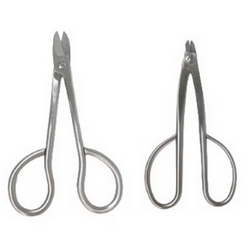
Wire Cutting Scissors - Apical
They are used to, after wiring and shaping the tips of the branches, simultaneously cut the wire and the branch.
0
Lateral Cutting Pliers
Its "oblique" cutting shape allows you to easily prune and remove branches by placing your hand at an angle that facilitates the perfect cut.
There is a model with narrower tips and grips for pruning Shohin (small-sized bonsai).

Concave Cutting Pliers
The cutting method allows, after the complete removal of a large branch, the creation of a clean concavity on the trunk that facilitates healing and improves the aesthetic outcome.
It is also sometimes used to "strip" wood from branches where Jin (Dead Wood) is intended to be made.

0
Round Side Cutting Pliers
It is possible, when cutting branches, for the final cut to be slightly concave, allowing in certain cases the use of a single tool.

Root Cutting Pliers
The cutting angle and the way the blades "beat" against each other (touching instead of overlapping as in all other tools), as well as the thickness of the cutting zone, allow the cutting of roots without "concavity," which encourages root growth in the cutting area instead of "closing" by healing as occurs with the cut made by the Concavo pliers.

Wire Cutter Pliers
This is the only tool for cutting aluminum wire (or copper for Bonsai), not to be used for cutting iron. The rounded tip makes it easier to remove the wires from Bonsai without damaging the tree bark.

Log Splitter Pliers
With a straight cutting angle and very thickening sides, this plier causes the "splitting" of the branches, allowing them to be then "split open" to take on a natural Jin shape (Dead Wood).

p
Jin Pliers
It is used to "strip" the branches to make Jin (Deadwood), either by pulling or by squeezing sideways to remove the bark from the branch. It is also very useful for placing and removing wires and for "anchoring" the wires during transplantation. There are models with a "straight head" or "side" head.

p
Defoliator
The self-opening blade system facilitates defoliation and pruning of apicals ("Metsumi pinching").

theScarifier Clamp
It combines two useful functions in a single tool: the tweezers for "Metsumi-pinching" and weed removal, and the scarifier for loosening roots during transplanting.
 Tweezer-Spatula
It combines two useful functions in a single tool: tweezers for "Metsumi-pinching" and weed removal, and a spatula for removing soil clumps from pots and pressing the soil after transplanting.
 Scarifier-Spatula
It combines two useful functions in a single tool: the scarifier to loosen the roots during transplanting, and the spatula to remove the soil clump from the pots and press the soil after transplanting.
 Jin Brushes
They come in different materials (nylon, boar bristles, or brass), are used for cleaning trunks and "Dead Wood" (in Jin, Shari, and Uros), and are also useful for removing and cleaning bark.
They come in different sizes and shapes, from straight to cylindrical curves or even conical.
