
Shopping Cart
There are no more items in your cart
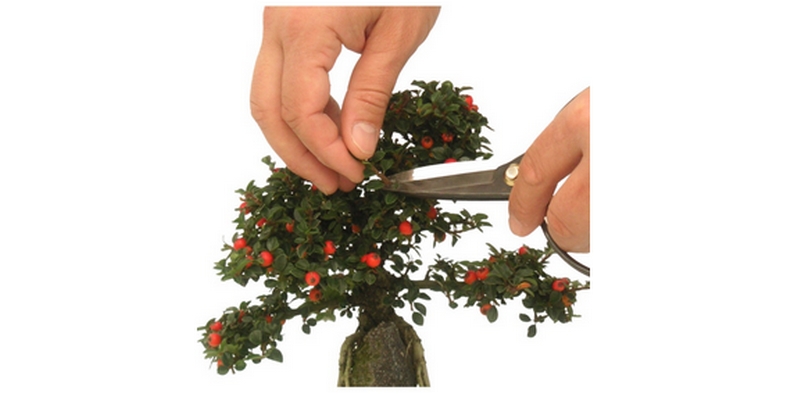
Pruning in Bonsai plays a fundamental role in maintaining the plant's aesthetics; like other techniques used in Bonsai, it involves specific methods of the art.
Through pruning (among other techniques), we shape and maintain the tree's form, giving it the appearance we “want,” and also achieve the reduction of leaf size and internodes (space between leaves), stimulate the plant's density (increase the number of leaves), and redistribute the energy in the Bonsai.
The principle applied in Bonsai pruning is very similar to hedge pruning; by cutting the apical buds (dominant), their energy stimulates axillary buds, which produce smaller sized leaves and shorter internodes. This way, we achieve subdivision of the branches, which increases the plant's density.
In Bonsai, there are different types of pruning, depending on the desired objectives and the species to apply it to:
Root Pruning - Performed during transplanting, it focuses on the thicker roots (support) with the aim to stimulate the finer ones (absorption).
For this pruning, a thick pruning shear or root pruning pliers should be used; these have a straight cutting angle (no concavity as with branch pruning pliers). This type of cut stimulates the growth of new roots at the cut zone.
Transformation Pruning – A strong pruning aimed at creating a Bonsai, or aesthetically reformulating a tree by altering its shape. This pruning consists of cutting thick branches of the plant and can be done with the help of pliers and saws designed for Bonsai.
After branch removal, the cut should be deepened with a concave cutter, which facilitates healing, especially on cuts larger than 5 mm, and apply healing agents to stimulate healing and protect against fungi and insects.

Maintenance Pruning – This type of pruning targets the new growth of the plant, aiming to maintain its shape, reduce leaf size and internode space, and finally control the energetically dominant branches, “strengthening” the weaker ones.
It is done with scissors and, in some cases, by hand.

Removal of Apicals (Metsumi in Japanese) – This technique consists of removing only the apical bud of the plant, right at the initial growth phase of the branch (after the emergence of 1 or 2 pairs). This way, we can maintain the shape of a Bonsai for longer and achieve smaller leaf sizes.
It is specific for very finely finished Bonsai where maintaining a stable shape as long as possible is desired, and for large-leaf species that show dominant leaf growth in spring budding (e.g., Ficus, Apple trees, Maple, Beech, etc.).

Pruning of Scale-like Plants – Plants whose leaves resemble scales (e.g., Juniperus, Cryptomeria, Chamaecyparis, etc.). These plants are pruned by pinching with the fingertips.
This method is used because if pruned with scissors, the cut area will turn yellow and dry out.

Pine Pruning – Pines are pruned when they start to shoot “candles” (growth zone of new buds) but before these stop growing and the needles start to elongate. By pruning (with the fingertips) at this growth phase, we stimulate the emission of several new buds, subdividing the branch and increasing the plant's density.

Defoliation – Although not strictly pruning, it can be grouped in this article and applies to large-leaf plants aiming to reduce leaf size, increase compaction, and improve autumn coloration (e.g., Acer).
It consists of the complete removal of leaves, leaving the petioles. It is applied during a growth phase of the plant when the leaf has matured and the leaf buds for the next year have formed; in Portugal, this is around July.

Often, we take advantage of this time to wire the plant since it is easier to perform this task, or in some cases to transplant (e.g., Ficus Retusa).
Partial defoliation (removing leaves from stronger branches and leaving those on weaker ones) serves to balance the plant's energy and strengthen weak areas.
Only defoliate healthy, strong plants that have been well fertilized throughout the previous spring. After defoliation, expose the Bonsai to the sun, control watering as the plant reduces water consumption, and do not fertilize until budding starts.
Apply weekly Bio Bonsai Activ