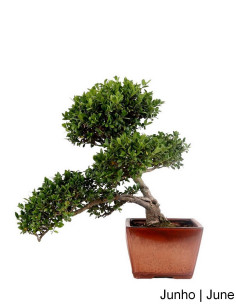
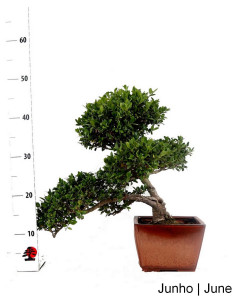
Common Name: Japanese Black Pine
Scientific Name: Pinus Thumbergii
Characteristics: A member of the Pinaceae family, it is native to Japan.
Bonsai evergreen with dark green needles (also called Japanese Black Pine), it is a pine from the coastal edge.
It is highly valued for its resistance and rustic bark. There is a variety that produces corky bark (Pinus Thunbergii Corticosa) and a small-needle variety (Pinus Thunbergii Kotobuki).
Its cultivation is very similar to that of other pines widely used in Bonsai such as Pinus Sylvestris or Pinus Mugo.
Location: Outdoors in full sun, where it receives 3 to 4 hours of direct sunlight per day (ideally in the morning or late afternoon), protected from strong winds and frost.
Watering: Water the soil abundantly until plenty of water comes out of the drainage holes, in order to moisten the soil evenly, always from above, never by immersion, using a fine-spout watering can.
Tips on watering can be found in the watering technical sheet.
Allow the top layer of soil to dry very well between each watering (to check if the plant needs water, touch the soil with your fingers).
If you have a tray under the Bonsai, never leave any water in it (to prevent root rot).
There is no advantage in misting the leaves; only do so on days you fertilize and if the fertilizer is specifically for foliar application, but make sure the leaves dry by night to avoid fungi.
Nutrition: From February to October, with a basic plan consisting of a complete fertilizer (Green & Gold Bonsai Organic or Biogold), and a biostimulant (Bio Bonsai Activ), which can also be combined with other products from our range.
Detailed information on how to combine these products with others from our range, or for a more specific nutrition plan, please refer to the complete nutrition plan technical sheet.
Pruning: Its vigorous growth requires cutting the candles at least twice a year. After the first cut, it regrows very strongly.
We should prune the stronger (larger) candles more, pruning the weaker (smaller) ones less or not at all, in order to balance the plant.
Tips on pruning can be found in the pruning and defoliation technical sheet.
Repotting: Using Conifer Bonsai Soil in February/March, when the candles begin to "move".
Details about repotting, post-repotting care and specific fortifiers you can use are available in the pruning and defoliation technical sheet.
Wiring: From late autumn to early spring, avoid wiring in summer.
Instructions on wiring can be found in the wiring technical sheet.