Shopping Cart
There are no more items in your cart


- -5%
- New

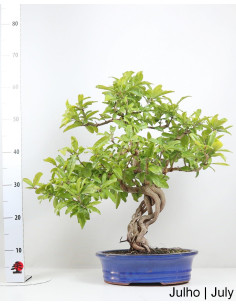
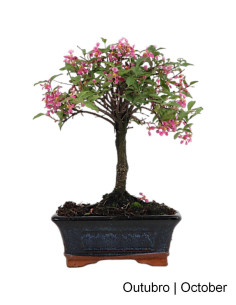
Species belonging to the Rubiaceae family (coffee plant), originating from Southern China and Japan.
Perennial shrub with small, oval leaves; there are some varieties, all having a variegated version (white and green leaf) which needs to be more exposed to the sun as it has less green "area" to perform photosynthesis.
The Serissa produces many flowers throughout the year, but mostly at the end of Summer.
The Serissa Bonsai is an indoor plant.
Gift Box Offer
Common Name: Serissa
Scientific Name: Serissa Foetida
Characterization: Belongs to the Rubiaceae family (coffee plant) and originates from Southern China and Japan. Its Latin name (phoetida = bad smelling) is due to the smell it emits when pruned.
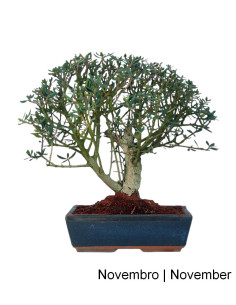
Bonsai evergreen with small oval leaves, produces many flowers throughout the year, but mainly at the end of Summer.
There are varieties more suitable for indoors (Chinensis) and others for outdoors (Japónica).
All have a Variegata version (white and green leaves) which needs to be more exposed to the sun as it has less green "area" to perform photosynthesis.
Location: Indoors near a window (maximum distance 50 cm), without curtains or blinds, where it receives 2 to 3 hours of direct sunlight per day, being rotated 180° weekly, away from heat sources or air conditioning. It can spend the warm months outside, but does not tolerate temperatures below 12°C (the Variegata can live outdoors all year round).
Watering: Water the soil abundantly until a lot of water comes out of the drainage holes, in order to evenly moisten the soil, always from above, never by immersion, using a watering can with fine holes.
Tips on watering, see the watering technical sheet watering.
They have a low water consumption and are sensitive to root fungi (if subjected to excess water and/or lack of light).
Let the surface layer of the soil dry between each watering (to confirm if the plant needs water, touch the soil with your fingers).
If you have a tray under the Bonsai, never leave any water in it (to prevent the roots from rotting).
There is no advantage in spraying the leaves; only do so on days when you fertilize and if the fertilizer is specific for foliar application, but make sure the leaves dry by night to avoid fungi.
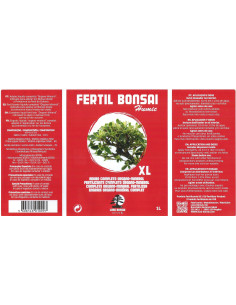
Nutrition: From February to November, with a basic plan composed of a complete fertilizer (Fertil Bonsai Humic, or Green & Gold Bonsai Organic or Biogold), and a biostimulant (Bio Bonsai Activ), which can also be combined with other products from our range.
Detailed information on how to combine these products with others from our range, or for a more specific nutrition plan, consult the complete nutrition plan technical sheet.
Pruning: Can be pruned like a "hedge" (with large grip scissors). It supports strong formative pruning up to the base branching, at the beginning of Summer, and then regrows stronger and more beautiful (dense).
Pruning tips, see the pruning and defoliation technical sheet.
Transplant: With Terra Bonsai Folhosas in April/May with strong pruning.
Details about transplant, post-transplant, and specific fortifiers you can use, see the transplant technical sheet.
Wiring: Uncommon, can be done all year, very brittle.
Wiring indications, see the wiring technical sheet.