Shopping Cart
There are no more items in your cart




- -5%
- New

Species originating from South America, belonging to the Fagaceae family.
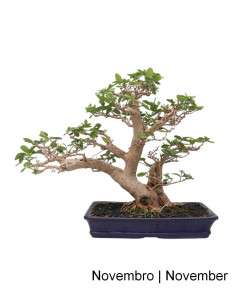
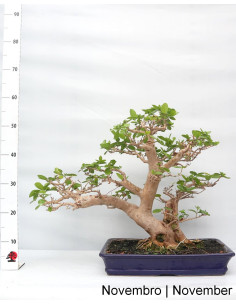
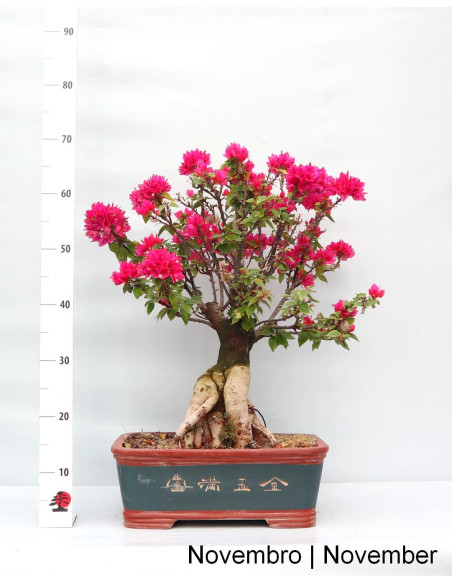
The Bougainvillea is a Bonsai with rapid growth, very resistant and well adapted to Mediterranean and mild climates where it produces flowers almost all year round. There are 2 most common varieties in Bonsai, with slight differences between them, the Glabra and the Spectabilis.
The Bougainvillea Bonsai is an Outdoor plant.
Common Name: Bougainvillea
Scientific Name: Bougainvillea Glabra and Bougainvillea spectabilis
Characterization: Originating from South America, it belongs to the Nyctaginaceae family.
It has marcescent leaves when grown in mild climates and deciduous leaves where it is colder. It is a fast-growing plant, with flowers ranging from pink to red, depending on the variety; there are currently varieties in yellow and even white.
The coloration we appreciate so much is actually not from the flower, but from 3 bracts (modified leaves) that protect the true flower; the small yellow tubes inside the flower are the actual flowers.
There are 2 varieties that are transformed into Bonsai :
Bougainvillea Glabra grows more like a "climber," making very strong shoots and emitting many thorns to attach itself, with slightly larger leaves, in a paler green and with a different hue between the upper and lower parts of the leaf. It produces abundant flowering in "clusters" at the tips of the branches in shades of pink-fuchsia-purple.
Bougainvillea Spectabilis has a more shrubby behavior, smaller dark green leaves, is more compact and slower growing, with far fewer thorns. It produces smaller flowers, grouped and closer to the crown. This variety is slightly more cold-resistant.
Location: In Mediterranean and mild climates, it should live outdoors year-round as long as it is protected from strong winds and frost. It needs at least 2 to 3 hours of direct sunlight and should be rotated 180° weekly.
In areas with harsher winters, it is advisable to protect it during winter in an indoor area without any kind of heating (e.g., a sunroom), near a window well exposed to sunlight with a minimum of 2 to 3 hours of sun. It should be rotated 180° weekly.
Watering: Water the soil abundantly until plenty of water drains out of the drainage holes, in order to moisten the soil evenly, always from above and never by immersion, using a watering can with fine holes.
Tips about watering, consult the watering technical sheet.
Allow the surface layer of the soil to dry slightly between each watering (to check if the plant needs water, touch the soil with your fingers).
If you have a tray under the Bonsai, never leave any water in it (to avoid root rot).
There is no advantage in misting the leaves; only do this on days you fertilize and if the fertilizer is for foliar application, but make sure the leaves dry by night to avoid fungi.
Nutrition: From February to October/November, follow a basic plan consisting of a complete fertilizer Fertil Bonsai Humic, or Green & Gold Bonsai Organic or Biogold, and a biostimulant (Bio Bonsai Activ), which can also be combined with other products from our range.
Detailed information on how to combine these products with others from our range, or for a more specific nutrition plan, consult the complete nutrition plan technical sheet.
Pruning: We should not let the shoots grow too long, except when we want to form new branches. This way, we can control that the flowers appearing at the top of the branch remain close to the tree. Let it grow 4 to 5 leaves and prune at the 2nd leaf is a good guideline.
Tips about pruning, consult the pruning and defoliation technical sheet.
Transplanting: With Leafy Bonsai Soil in February/March, with strong partial defoliation.
Details about transplanting, post-transplant care, and specific fortifiers you can use can be found in the transplanting technical sheet.
Wiring: It can be wired all year round.
Instructions about wiring, consult the wiring technical sheet.