Shopping Cart
There are no more items in your cart

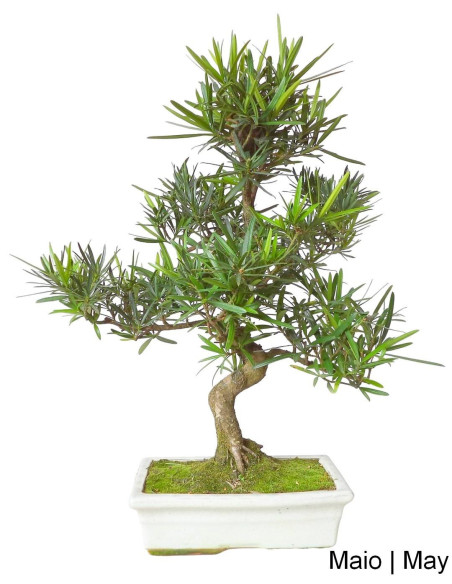
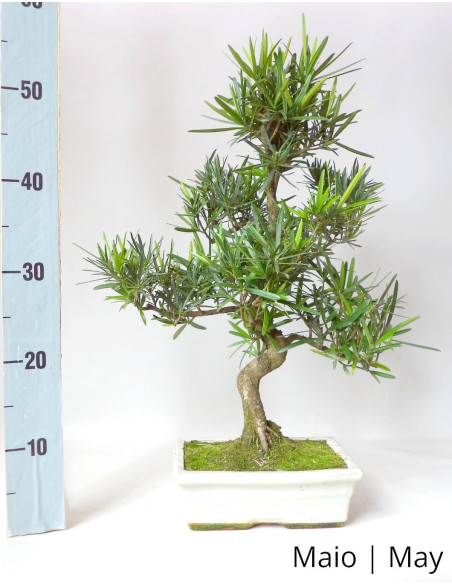


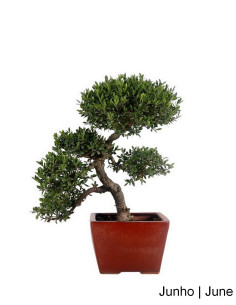
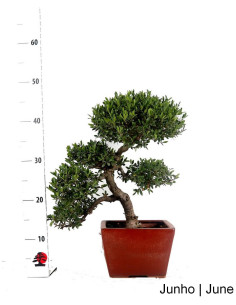
Species originating from China and Korea, belonging to the Podocarpaceae family.
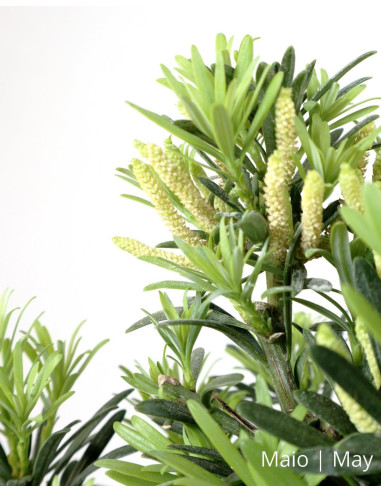
It is an evergreen tree with long oval leaves, dark shiny green in color, arranged spirally around the branches. For Bonsai, two varieties are used: one with larger leaves (about 5 to 8 cm in length) and the "Maki" variety with smaller leaves (3 to 5 cm). It is also known as Buddha Pine.
The Podocarpus Bonsai is an outdoor plant.
Common Name: Podocarpus
Scientific Name: Podocarpus spp
Characterization: Originating from China and Korea, it belongs to the Podocarpaceae family.
An evergreen tree with long oval leaves, shiny dark green in color, arranged spirally around the branches.
In Bonsai, two varieties are used: one with larger leaves (about 5 to 8 cm long) and the "Maki" variety with smaller leaves (3 to 5 cm).
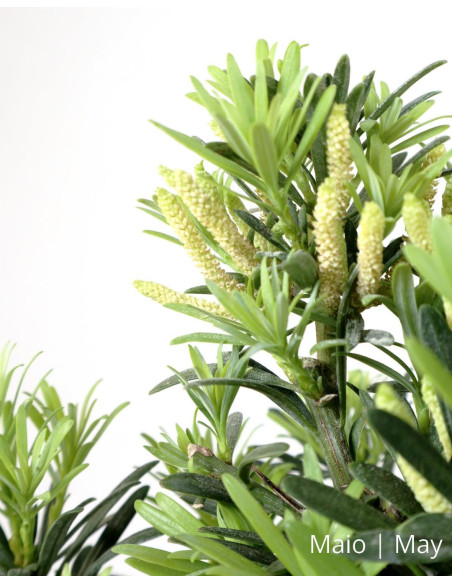
It is a dioecious plant with male and female flowers on separate trees, with no easy differentiation.
After flowering in yellow tones (in Spring), some females manage to produce fruit, a berry with a purplish color similar to a grape, and it is edible.
Commonly known as "Buddha Pine," it is widely used in Japanese gardens, either as hedges or as shade trees (it can reach up to 20 meters), and Feng Shui enthusiasts attribute many positive properties to it.
Location: Although it is indicated as an indoor plant, in our climate it must live outdoors, always well exposed to the sun, where it receives 2 to 3 hours of direct sunlight per day (ideally in the morning or late afternoon), protected from strong winds and frost.
Only in cases of extreme frost and prolonged low temperatures (below 0°C) would it need temporary protection.
Watering: Water the soil abundantly until plenty of water comes out of the drainage holes, to uniformly moisten the soil, always from above never by immersion, using a watering can with fine holes.
Tips about watering, see the watering technical sheet watering.
Allow the surface layer of soil to dry slightly between each watering (to check if the plant already needs water, touch the soil with your fingers).
If you have a tray under the Bonsai, never leave any water in it (to prevent the roots from rotting).
There is no advantage in misting the leaves; only do so on days when fertilizing and if the fertilizer is specifically for foliar application, but ensure the leaves dry by nightfall to avoid fungi.
Nutrition: From February to October/November, follow a basic plan composed of a complete fertilizer (Fertil Bonsai Humic, or Green & Gold Bonsai Organic or Biogold), and a biostimulant (Bio Bonsai Activ), which can also be combined with other products from our range.
Detailed information on how to combine these products with others from our range, or for a more specific nutrition plan, see the complete nutrition plan technical sheet.
Pruning: Done above a leaf spiral trying not to cut the leaves in half. Pruning can be done at any time of the year, as it regrows well after pruning (back budding) and compacts very well.
Pruning tips, see the pruning and defoliation technical sheet.
Repotting: Although it is a conifer, Broadleaf Bonsai Soil is used in February/March, before bud break.
When repotting, small nodules are found along the roots; this is not a problem but a symbiotic relationship between the plant and a fungus that facilitates nitrogen uptake, fixation, and assimilation.
Details about repotting, post-repotting care, and specific fortifiers you can use can be found in the repotting technical sheet.
Wiring: Since it is very flexible, it can be wired all year round, but care must be taken not to damage the leaves when passing the wire.
Wiring guidelines can be found in the wiring technical sheet.