Shopping Cart
There are no more items in your cart




- -5%

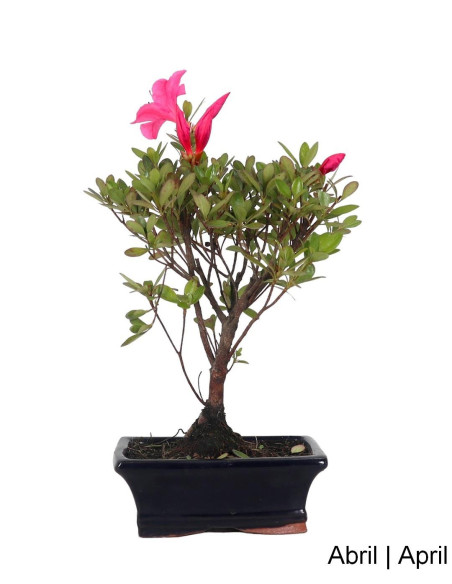
Member of the Ericaceae family, it originates from Japan.
It is a species highly appreciated for its flowering, which in some varieties can have different shades on the same plant (and have different colors on the same flower).
The Azalea Bonsai is an outdoor plant.
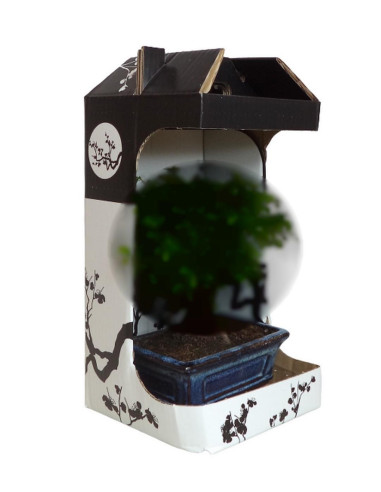
Gift Box Offer
Common Name: Azalea
Scientific Name: Azalea Indica
Description: Member of the Ericaceae family, originating from Japan.
A shrub that can be semi-deciduous or evergreen, depending on the variety, with oval bright green leaves.
It is highly appreciated for its flowering, which in some varieties can have different shades on the same plant (and different colors on the same flower). The most valued variety is the "Satsuki," which comes from Kanuma in Japan, a place where the specific soil for Azaleas is collected.
Location: Outdoors, where it receives 2 to 3 hours of direct sunlight per day (ideally in the morning or late afternoon), protected from strong winds and frost. During flowering, it should be protected from direct rain (but always kept outdoors), which will cause the flowers to wilt.
Watering: Very abundant during flowering. As it is sensitive to limestone, use good quality water (preferably mineral water at the end stage!) and avoid wetting the leaves, only doing so during foliar fertilization.
Water the soil abundantly until a lot of water flows out of the drainage holes, to uniformly moisten the soil, always from above and never by immersion, using a watering can with fine holes.
Tips about watering, see the watering technical sheet watering.
Let the surface layer of the soil dry slightly between each watering (to confirm if the plant needs water, touch the soil with your fingers), considering it has a high water consumption in summer.
If you have a tray under the Bonsai, never leave any water in it (to prevent the roots from rotting).
There is no advantage to misting the leaves; only do so on days when fertilizing and if the fertilizer is for foliar application, but ensure the leaves dry by night to avoid fungi.
Nutrition: From February to October, with a basic plan composed of a complete fertilizer (Fertil Bonsai Humic, or Green & Gold Bonsai Organic or Biogold), and a biostimulant (Bio Bonsai Activ), which can also be combined with other products from our range.
Detailed information on how to combine these products with others from our range, or for a more specific nutrition plan, please consult the complete nutrition plan technical sheet.
Pruning: Contrary to most trees, it does not have apical dominance; you must always leave "green mass" at the apex.
New shoots that cover the flowers should be removed before they open so that direct sunlight stimulates both the flowers and the formation of leaf buds around the floral bud.
After flowering, select 2 well-located shoots from those that grow from the flowering site and remove the floral ovaries (small fruits that appear in the flower area) because if left, the plant will be greatly weakened and may even die.
See how to perform specific pruning in the azalea post-flowering work technical sheet.
Transplanting: With Terra Bonsai Azaleas or Kanuma pure, after flowering in May/June together with formation pruning, or in February/March for plants that you decide not to let flower that year (weakened plants or those still in formation where modeling is prioritized).
Details about transplanting, post-transplant care, and specific fortifiers you can use are available in the transplanting technical sheet.
Wiring: Wiring from October to spring; during spring and post-flowering (May to August) branches are poorly formed and break easily, but always be very careful as the Azalea is very brittle.
Guidelines on wiring, please see the wiring technical sheet.